


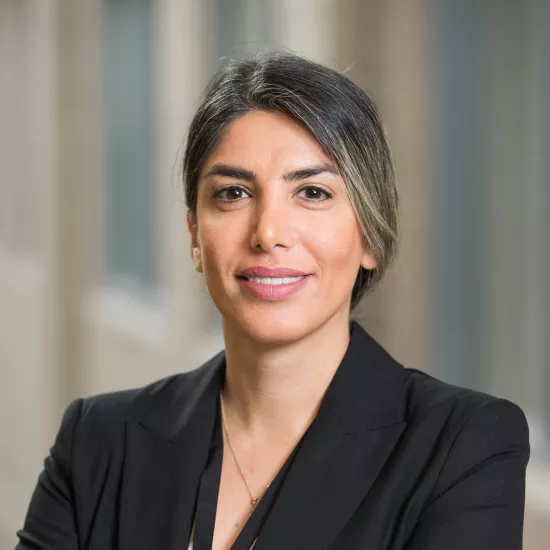
Samira Ghorbani
-
E-mail:
-
Phone:
-
Room:SB3012
-
Mailing Address:
3359 Mississauga Road
Mississauga ON L5L1C6
Canada
Tier 2 Canada Research Chair in Myelin Repair and Matrix Biology of Aging
Education
- Ph.D in Immunology, Tehran University of Medical Sciences 2017
- MSc, Isfahan University of Medical Sciences 2011
- BSc, Tehran University 2007
Research
Research in our lab focuses on overcoming inhibitors in multiple sclerosis (MS) lesions to enhance repair and neuroprotection. MS is a condition in which the body's immune system mistakenly attacks the protective covering of nerves, known as myelin, in the brain and spinal cord. However, the body has a natural repair process called remyelination, which rebuilds the myelin and restores physical function. This process is vital for protecting nerve fibers from further damage. How to improve remyelination during multiple sclerosis is an active area of research with important health implications, particularly in the context of aging. The extracellular matrix molecules deposited into lesions provide both an altered microenvironment that inhibits remyelination, and a fuel that exacerbates inflammatory responses within lesions. Our lab aims to advance our knowledge about intricate relationship between the extracellular matrix, immune and glial cell of the central nervous system to discover new therapeutic targets to promote remyelination, so slowing progression and neurodegeneration.
Lab Opportunities
The Ghorbani Lab is currently recruiting students. Please email a CV and contact details for three references directly to Dr. Ghorbani (samira.ghorbani@utoronto.ca). Serious graduate candidates should subsequently apply to the University of Toronto Department of Cell & Systems Biology (CSB) graduate program. Admission requirements can be found through the CSB page, here.
Recent Publications
For a complete list of publications, visit Dr. Ghorbani's PubMed page.
- Lozinski, B. M., Ghorbani, S., & Yong, V. W. (2024). Biology of neurofibrosis with focus on multiple sclerosis. Frontiers in Immunology, 15, 1370107. https://doi.org/10.3389/fimmu.2024.1370107
- Stephenson, E. L., Jain, R. W., Ghorbani, S., Gorter, R. P., D’Mello, C., & Yong, V. W. (2024). Uncovering novel extracellular matrix transcriptome alterations in lesions of multiple sclerosis. International Journal of Molecular Sciences, 25(2), 1240. https://doi.org/10.3390/ijms25021240
- Zhang, R., Dong, Y., Liu, Y., Moezzi, D., Ghorbani, S., Mirzaei, R., Lozinski, B. M., Dunn, J. F., Yong, V. W., & Xue, M. (2023). Enhanced liver X receptor signalling reduces brain injury and promotes tissue regeneration following experimental intracerebral haemorrhage: Roles of microglia/macrophages. Stroke and Vascular Neurology. https://doi.org/10.1136/svn-2023-002331
- Xue, S., Lozinski, B. M., Ghorbani, S., Ta, K., D'Mello, C., Yong, V. W., & Dong, Y. (2023). Elevated Galectin-3 is associated with aging, multiple sclerosis, and oxidized phosphatidylcholine-induced neurodegeneration. The Journal of Neuroscience, 43(15), 2616–2630. https://doi.org/10.1523/JNEUROSCI.2312-22.2023
- Mohammadi-Kordkhayli, M., Sahraian, M. A., Ghorbani, S., Mansouri, F., Talebi, F., Noorbakhsh, F., & Saboor-Yaraghi, A. A. (2023). Vitamins A and D enhance the expression of Ror-γ-targeting miRNAs in a mouse model of multiple sclerosis. Molecular Neurobiology, 60, 4161–4173. https://doi.org/10.1007/s12035-023-03427-3
- Li, H., Ghorbani, S., Ling, C., Yong, V. W., & Xue, M. (2023). The extracellular matrix as modifier of neuroinflammation and recovery in ischemic stroke and intracerebral hemorrhage. Neurobiology of Disease, 184, 106282. https://doi.org/10.1016/j.nbd.2023.106282
- Li, H., Ghorbani, S., Zhang, R., Ebacher, V., Stephenson, E. L., Keough, M. B., Yong, V. W., & Xue, M. (2023). Prominent elevation of extracellular matrix molecules in intracerebral hemorrhage. Frontiers in Molecular Neuroscience, 16, 1251432. https://doi.org/10.3389/fnmol.2023.1251432