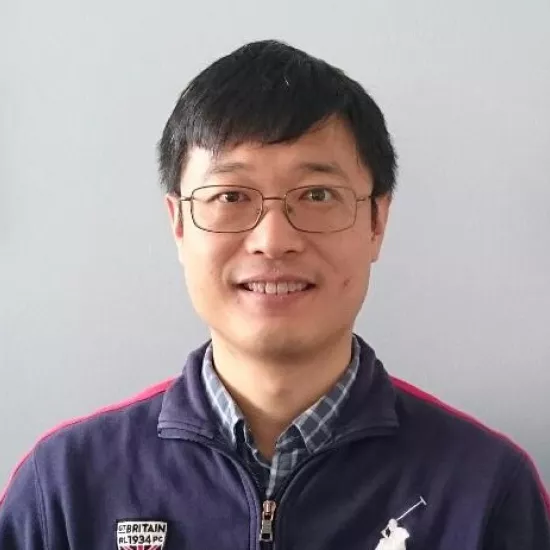
Baohua Liu
Title/Position
Associate Professor
✅ Accepting Graduate Students
-
E-mail:
-
Phone:
-
Website:
-
Room:DV3049
Education
- PhD, University of Southern California (2010)
- MSc, Nankai University (2002)
- BSc, Nankai University (1999)
Current Courses
- BIO361: Biometrics II
- BIO408: Neural Circuit Structure and Function
- CSB1020: Current Techniques in Neuroscience
Research
The ultimate goal of my lab is to identity the neural circuits underpinning the interaction of visual and oculomotor functions, and to understand the computational principles governing this biological phenomenon.
Currently, we are mainly working on two projects.
- When our heads rotate or the surrounding environment moves, the resulting retinal slips will be compensated by an involuntary eye movement called optokinetic reflex or OKR. Even though this reflexive behavior is drive by hardwired circuits in the brainstem, it is highly plastic. For instance, the amplitude of OKR can be adaptively potentiated when other ocular motor reflexes are impaired or in response to repetitive OKR training. This plasticity is an essential property of the OKR as it enables this fundamental behavior to be continuously readjusted to maintain image stability as the animal grows and ages. We found that the visual cortex has a profound impact on the plasticity of this innate behavior. This cortical function relies on a specific descending pathway that connects the visual cortex to the OKR circuits in the brainstem. We aim to uncover the cellular and circuitry mechanisms underlying the cortical contribution to the adaptive plasticity of OKR behavior.
- The brainstem is a center supporting vital physiological functions. Many brainstem nuclei mediate reflexive behaviors which are essential for animal’s survival, such as breathing, eating and escaping from dangers. In spite of the importance of the brainstem, it remains largely unknown what neuronal types make up the brainstem circuits, how they are connected, how they process sensory information or generate motor commands and how their activities lead to behavioral outcomes. To address those questions, we decide to use the OKR as the model since this behavior can be accurately quantified in our lab.
Current Lab Members
- Yingtian (Hayley) He, PhD Student
- Milena Russo, PhD Student
- Baojun Tang, PhD Student
- Xiaolin Chou, Postdoctoral Fellow
Become a Lab Member
We are currently looking for 1-2 graduate students, a postdoctoral fellow, and various undergraduate students to join our team. For up-to-date information on current recruitment in the Liu Lab, please visit the 'Opportunities' page on the Liu Lab website. If interested, potential candidates should contact Dr. Liu directly (baohua.liu@utoronto.ca).
Recent Publications
For a complete list of publications, visit Dr. Liu's Google Scholar page.
- He Y, Chou XL, Lavoie A, Liu J, Russo M, Liu BH (2024) Brainstem inhibitory neurons enhance behavioral feature selectivity by sharpening the tuning of excitatory neurons. Current Biology 34:1-16.
- Liu J, He Y, Lavoie A, Bouvier G, Liu BH. (2023) A Direction-selective Cortico-Brainstem Pathway Adaptively Modulates Innate Behaviors. Nature Commun. 14:8467.
- Liu J, Liu BH. (2023) Quantification of Visual Feature Selectivity of the Optokinetic Reflex in Mice. Journal of Visualized Experiments. doi: 10.3791/65281.
- Hegazi S, Cheng AH, Krupp JJ, Tasaki T, Liu J, Szulc DA, Ling HH, Rios Garcia J, Seecharran S, Basiri T, Amiri M, Anwar Z, Ahmad S, Nayal K, Sonenberg N, Liu BH, Cheng HLM, Levine JD, Cheng HM. (2022) UBR4/POE facilitates secretory trafficking to maintain circadian clock synchrony. Nature Commun. 13:1594.
- Lowden C, Boulet A, Boehler NA, Seecharran S, Rios Garcia J, Lowe NJ, Liu J, Ong JLK, Wang W, Ma L, Cheng AH, Senatore A, Monks DA, Liu BH, Leary SC, Cheng HM. (2021) Homeostatic control of nuclear-encoded mitochondrial gene expression by the histone variant H2A.Z is essential for neuronal survival. Cell Rep. 36:109704.
- Lee C, Lavoie A, Liu J, Chen SX & Liu BH (2020) Light Up the Brain: The Application of Optogenetics in Cell-Type Specific Dissection of Mouse Brain Circuits. Front. Neural Circuits. 14:18. doi: 10.3389/fncir.2020.00018. eCollection.
- Lavoie A & Liu BH (2020) Canine Adenovirus 2: A Natural Choice for Brain Circuit Dissection. Front. Mol. Neurosci. 13:9. doi: 10.3389/fnmol.2020.00009. eCollection.