Details & Registration for the Frontiers of Innovation Conference: Poster Competition

The 2026 Frontiers of Innovation Conference
Quantum Computing: Fact, Fiction, and the Human Factor
Will quantum computing “supercharge” artificial intelligence and change the world?
The University of Toronto Institute for Management & Innovation (IMI), in collaboration with the Centre for Quantum Information and Quantum Control (CQIQC) is pleased to invite you to the 2026 IMI Frontiers of Innovation Conference.
The 2026 Conference is the fourth in a series of annual conferences. Previous conferences focused on the use of artificial intelligence to fight crimes such as human trafficking, the illegal wildlife trade, and the production and distribution of fentanyl. This year the conference will focus on the potential implications of quantum computing.
About the 2026 Conference
Have you heard of quantum computing? Is it the next BIG THING? Will quantum computing take artificial intelligence to a much higher level? Join us for a clear, candid look at a technology poised to influence how organizations compete and how people will live and work.
Quantum computing is a new kind of computer that could solve certain problems that are beyond the capability of today’s machines. For the right tasks, it may turn work that takes years, into minutes. More than speed, it could reveal new ways to enhance healthcare, design better products, build smarter infrastructure, and create stronger systems, while raising vital questions about ethics, talent, and responsible use.
JOIN US. This conference is free and open to everyone. A light luncheon will be provided. No technical background is required, and no familiarity with quantum computing is necessary. The conversations will be clear, engaging, and relevant to all. Expect real‑world explanations, lively discussion, and straightforward views on the future of this significant emerging technology.
Attendees & Schedule
Attendees do not need a quantum computing background and will find significant value in this very interesting half-day event. The event is open to the public and it is free to attend!
There will be poster board displays and light lunch from 11:30 am to 1:00 pm, and the Conference will begin at 1:00 pm.
Location
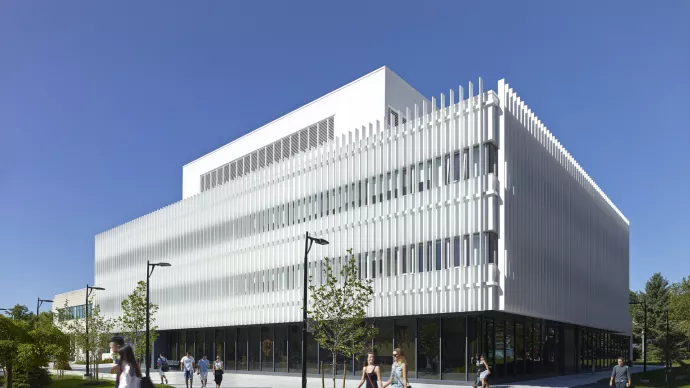
This in-person event is being held in the Innovation Complex Rotunda at the University of Toronto Mississauga campus.
Registration

Kevin Yousie, Conference Co-Chair
Associate Professor, Teaching Stream
Academic Director, IMI Big Data & Artificial Intelligence Hub
Institute for Management & Innovation (IMI), University of Toronto Mississauga

Anna Dyring, Conference Co-Chair
Quantum Strategic Initiative Lead
Centre for Quantum Information and Quantum Control, University of Toronto
Join us in Mississauga
Directions & Parking
TOPIC
2026 Frontiers of Innovation Conference: Quantum Computing: Fact, Fiction, and the Human Factor
DATE
Saturday, March 28, 2026
TIME
11:30 am - 5:00 pm
LOCATION
Innovation Complex
University of Toronto Mississauga
3359 Mississauga Road
Mississauga, ON
L5L 1C6
Open to everyone
Conference Agenda
| Time | Agenda |
| 11:30 am - 1:00 pm | Arrival Registration desk/check in opens Poster Competition and networking with participants, speakers and panelists A light luncheon will be available at noon |
| 1:00 pm | Conference Begins |
| 1:00 pm - 4:30 pm | Welcome Remarks Kevin Yousie, Conference Co-Chair Anna Dyring, Conference Co-Chair Presenters 
An Introduction and Overview of Quantum Computing Daniel F. V. James, Speaker 
Break (20 minutes) Panel Discussion 
Andrew Petersen, Panel Moderator 
Isabelle Lacroix, Panelist 
Hemavathi Santhanam, Panelist 

|
| 4:30 pm | Poster Competition: Announcing the Winners and Awarding of Prizes Closing Comments |
| 5:00 pm | Conference Adjourns |
Daniel F. V. James, Presenter
Professor, Department of Physics
University of Toronto
Daniel James has been a Professor of Theoretical Physics at the University of Toronto since 2005, specializing in the study of optical phenomena and the development of quantum technologies. Among his successes are the first complete demonstration of quantum teleportation, and the first implementation of a factoring algorithm with a prototype quantum computer. He recently published a new textbook Quantum Information: A First Course (Cambridge University Press, 2025) which explains the fundamentals of the field at a level appropriate for undergraduates.
Luke Govia, Speaker
Manager
Quantum Technologies at CMC Microsystems
Luke Govia is the Manager of the Quantum Technologies group at CMC Microsystems, where he leads a team focused on accelerating the adoption of quantum technologies in Canada. CMC manages FABrIC, an Innovation, Science and Economic Development Canada (ISED) Strategic Response Fund (SRF) investment, that supports these efforts. Prior to joining CMC, Luke was a research scientist and principal investigator at IBM Quantum and at RTX BBN Technologies in the United States. He completed his Ph.D. in Physics at Saarland University in Germany, and holds an M.Sc. in Quantum Information and a B.Sc. in Mathematical Physics from the University of Waterloo. He is currently a member of the Unitary Foundation's Open Quantum Benchmark Committee, and from 2021-2023 was the Secretary-Treasurer of the Division of Quantum Information of the American Physical Society. His research interests lie in quantum characterization and benchmarking, superconducting device theory, quantum error mitigation, and neuromorphic computing.
Andrew Petersen, Panel Moderator
Professor, Teaching Stream & Vice Chair (CSC)
Department of Mathematical and Computational Sciences, University of Toronto Mississauga
Andrew Petersen is a Professor, Teaching Stream in the Department of Mathematical and Computational Sciences at the University of Toronto Mississauga, where he has been a faculty member since 2007. His research is in computing education, with a focus on introductory computing courses and the role of belonging in academic self-efficacy. He is an Association of Computing Machinery Distinguished Member (2024) and a recipient of U of T's President's Teaching Award (2015) and the Ontario Confederation of Faculty Associations Teaching and Academic Librarianship Award (2019). Andrew has held significant leadership roles in the computing education community, including General Chair of the ACM International Computing Education Research Conference (ICER) in 2019 and Koli Calling in 2021 and 2022, and he currently chairs the ICER Steering Committee. Within the university, he serves as Vice Chair (Computer Science) and as the UTM teaching staff representative on the University of Toronto Governing Council.
Professor Isabelle Lacroix, Panelist
Quantum Accomplice
Vice-Dean for Development and International Affairs, Faculty of Arts and Humanities
Director, School of Applied Politics, Faculty of Arts and Humanities
University of Sherbrooke
Isabelle Lacroix has been a professor at the École de politiques appliquées at the Université de Sherbrooke since 2008 and vice-dean of development and international affairs at the Faculty of Arts and Humanities since 2021. Her main areas of research and teaching are Canada and Québec public policies, with a particular focus on technology development policies, the societal impacts of disruptive technologies, and the social responsibility of researchers. Using science fiction “as a political laboratory,” she edited Les enseignements de Dune, Enjeux actuels dans l’œuvre phare de Frank Herbert (2020) and co-edited D’Asimov à Star Wars, Représentations politiques dans la science-fiction (2016) for Presses de l’Université du Québec. Since 2019, she has been working at the Quantum Institute as a research associate, developing the study of the societal impact of quantum technologies through social dialogues.
Hemavathi Santhanam, Panelist
Solution Architect (watsonx Data & AI), IBM Canada Lab
IBM Quantum Ambassador & Qiskit Advocate
Hemavathi Santhanam is a Quantum Computing enthusiast with a deep understanding and hands-on with Qiskit Optimization, Machine Learning, and Nature stacks. With a rich background in engineering and services business units at IBM, Hema is a programmer at heart having worked across design, development, and automation of world class products. With a MS in Computing and Data Analytics, she is recognized with skills in applying ML techniques, data engineering concepts, and building generative AI solutions to solve real-world business problems. As an IBM Quantum Ambassador and Qiskit advocate, she has presented and conducted Qiskit workshops at events like quantum conferences, tech expos, meetups, universities. She has also co-authored research articles and collaborate with research scientists with special focus on healthcare and life sciences.
Daniel Nino, Panelist
Research Engagement Lead
Xanadu
Daniel is a Research Engagement Lead at Xanadu, where he leads academic engagements, hardware commercialization initiatives, and helps manage hardware partnerships and collaborations. He holds a MSc. in Physics from the University of Toronto, with a research focus on ultracold atomic physics. He also holds a PhD from the University of Toronto specializing in single-molecule biophysics. After a brief postdoc, Daniel taught physics and engineering in various departments at the University of Toronto before joining Xanadu in 2023.
Dr. Albert Chen, Panelist
Partner
Two Small Fish Ventures
Albert is a partner at Two Small Fish Ventures. His expertise spans the full spectrum—from technical innovation to product development to operational leadership in entrepreneurial startups. His impressive academic background further underscores his exceptional capabilities.
Albert earned his Ph.D. in BioMEMS, Acoustics, and Medical Engineering from the University of Waterloo. He also completed his undergraduate studies in Systems Design Engineering at Waterloo and participated in an international exchange program in Electrical Engineering at National Taiwan University.
Albert’s professional career is equally remarkable. Most notably, he served as the CTO of robotics and edge AI company Forcen. His diverse experience also includes roles at Metergy (smart energy), Excelitas (photonics), and North (smart glass, acquired by Google).
This is just a glimpse of Albert’s impressive journey. Follow him on LinkedIn to learn more about his background and accomplishments.
At Two Small Fish Ventures, we are committed to supporting bold founders shaping the future of technology through our experience. Albert’s extensive academic background, combined with his hands-on leadership and innovation experience, makes him an invaluable addition to our team.

Thank you to our sponsors