
Research
1) Oceanographic controls on Galapagos and Tropical Eastern Pacific Carbonates
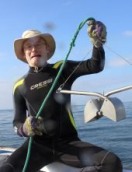
Our multinational research effort in the Eastern Pacific focuses on tropical carbonate formation and microfossil assemblages under exceptional oceanographic conditions. While different carbonate systems will be compared in Eastern Pacific locations over the next years, we have initiated research on Galapagos Island carbonates and microfossils which form in a setting of enriched nutrients and naturally low ocean pH.
2) Millennial-scale sclerochronology of coralline algal carbonates for reconstructing sea surface temperatures of extratropical seas
Core activities of my research group are concerned with using coralline red algae as high-resolution archives of late Quaternary marine climates. Focusing on mid- and high-latitude regions we are currently generating multicentury to millenial-scale algal-based climate records from the Bering Sea, northwest Atlantic and Arctic Ocean. Below are several examples of ongoing coralline algal proxy reconstructions.
Click for details
2a) Multicentury reconstructions of Labrador Current dynamics
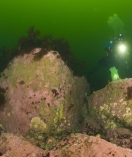
Recently collected coralline algae from central and northern Labrador will be used to provide the first >500 year record of Labrador Current temperature and salinity variability and related climate oscillations in the northwestern Atlantic, a region where poorly understood climate and oceanographic changes have had a dramatic impact on ecosystems and fishery yields.
2b) Annually-resolved Arctic sea ice variability
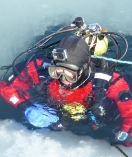
The most concerning example of ongoing climate change is the rapid Arctic sea-ice retreat. While just a few years ago ice-free Arctic summers were expected by the end of this century, current models predict this to happen by 2030. This shows that our understanding of rapid changes in the cryosphere is limited, which is largely due to a lack of long-term observations. Newly discovered long-lived algae growing on the Arctic seafloor and forming tree-ring like growth bands in a hard, calcified skeleton have recorded centuries of sea ice history. The algae show that, while fast short-term changes have occurred in the past, the 20th century exhibited the lowest sea-ice cover in the past 646 years. Recent expeditions lead to collections of algae living in regions of temporal sea-ice cover in the Canadian Northwest Passage, Greenland and Spitsbergen.
2c) Has Ocean Acidification begun affecting coralline algal skeletons?
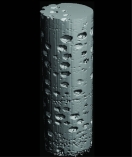
Ongoing ocean acidification has been shown to potentially have a detrimental impact on the skeletons of calcareous plants and animals such as shellfish and corals. This is especially true in cold-water regions such as the subarctic North Pacific and northwest Atlantic, which are predicted to be amongst the first negatively affected by a decreasing ocean pH. Long-lived coralline algae from both ocean basins are being analyzed for temporal changes in skeletal structure and elemental composition, and as a proxy for reconstructing ocean pH over several centuries.
2d) Can we use coralline algae to reconstruct Greenland ice sheet runoff?
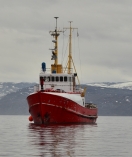
In collaboration with the Greenland Institute of Natural Resources we conducted a first field survey in summer 2013 in the Gotharb Fjord, Nuuk, to collect coralline algae with lifespans of up to 150 years. We found that massive plants of Clathromorphum sp., a widespread genus in the Subarctic and Arctic, are abundant components of hard substrates inside the Fjord. We are now analyzing this material to provide a record of Fjord temperatures and glacial melting of the Greenland ice sheet.
2e) Bering Sea sea surface temperature variability
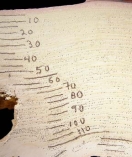
Recent changes in the subarctic climate of the northern Pacific Ocean had dramatic effects on ecosystems and fishery yields, but these climate dynamics are poorly understood because of the absence of century-long high-resolution marine records that far north. We generated a 117-year record of marine climate history based on oxygen isotope patterns that indicate freshening and warming of surface waters after the middle of the twentieth century. The time series developed correlates with the decades-long Pacific Decadal Oscillation and the shorter-duration El Nino-Southern Oscillation (ENSO).
Click for details
3) Influence of Nutrients on Extratropical Shallow Water Carbonates and Benthic Foraminifera
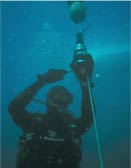
As part of an interdisciplinary international research effort, the complex interplay of nutrients and other oceanographic controls on modern shallow water carbonate depositional systems was quantified. We combined long-term field monitoring of oceanography with sedimentologic and biologic investigations in a range of modern carbonate environments distributed along a latitudinal gradient in the natural field laboratory of the Gulf of California, Mexico.Currently, my group is analyzing benthic foraminifera throughout the Gulf of California to decipher ecological zonations and compare assemblages to oceanographic controls.
Go to Section...
4) Miocene carbonates as indicators of climate change
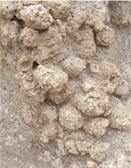
Faunal or floral turnovers and community replacements are commonly observed throughout geologic history in carbonate settings and can be attributed to a variety of climatic, plate tectonic, oceanographic, biogeographic, and evolutionary controls. Sea-level fluctuations and changes in temperature and nutrients, which are supplied to the shallow ocean by either land runoff or vertical mixing processes such as upwelling, are the most important controls over short- and medium-term time scales.
Click for details
5) Annually-resolved high-latitude climates during the Paleocene/Eocene derived from exceptionally preserved wood
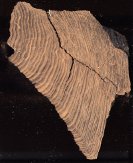
We are currently exploiting the recent finding of exceptionally well-preserved subfossil wood in volcanoclastic deposits associated with early Paleogene kimberlite pipes (55.1 Ma) in the Northwest Territories, Canada, to explore terrestrial climate variability during a period of warmth.
Click for details
6) Coral-based reconstructions of Caribbean climate and terrestrial runoff
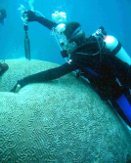
The goals of this research are to examine recently collected century-long coral reef records from Tobago, which has seen an increase in terrestrial runoff during the last decades. Using luminescence and trace element analysis (Sr/Ca and Ba/Ca) we study climate variability and runoff.
Click for details
7) Environmental Aspects of Deep-Sea Mining
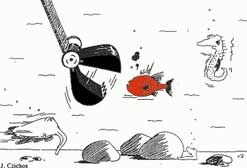
In addition to numerous human-induced negative impacts to ocean ecosystems, a potential future threat has been the long-predicted onset of mineral exploitation in the deep sea. Deep-sea mining has now become economically and technologically feasible and is predicted to start in the near future. However, there are serious concerns about environmental management strategies of mining activities.
Design © Anshu